Don’t pull the wrong block! Why species-targeted treatment needs ecosystem data

The most common treatment framework in clinical microbiome practice — identify a problematic species, remove it, support what's missing — has an uncomfortable gap at its foundation. It assumes that species can be managed independently within a system that is fundamentally interdependent.
The appeal of targeted intervention
Targeted treatment is interventions are satisfying. The test identifies an elevated species. The practitioner applies an antimicrobial protocol, a probiotic intervention, or a dietary strategy aimed at shifting that species. There's a clear logic: problem identified, action taken.
The approach mirrors how clinical medicine handles acute infections — and for good reason. When a single pathogen drives the disease process, specificity is the right strategy.
But the gut microbiome isn't an infection. It's an ecosystem. And ecosystems don't respond to targeted interventions the way individual pathogens do.
The interdependence problem
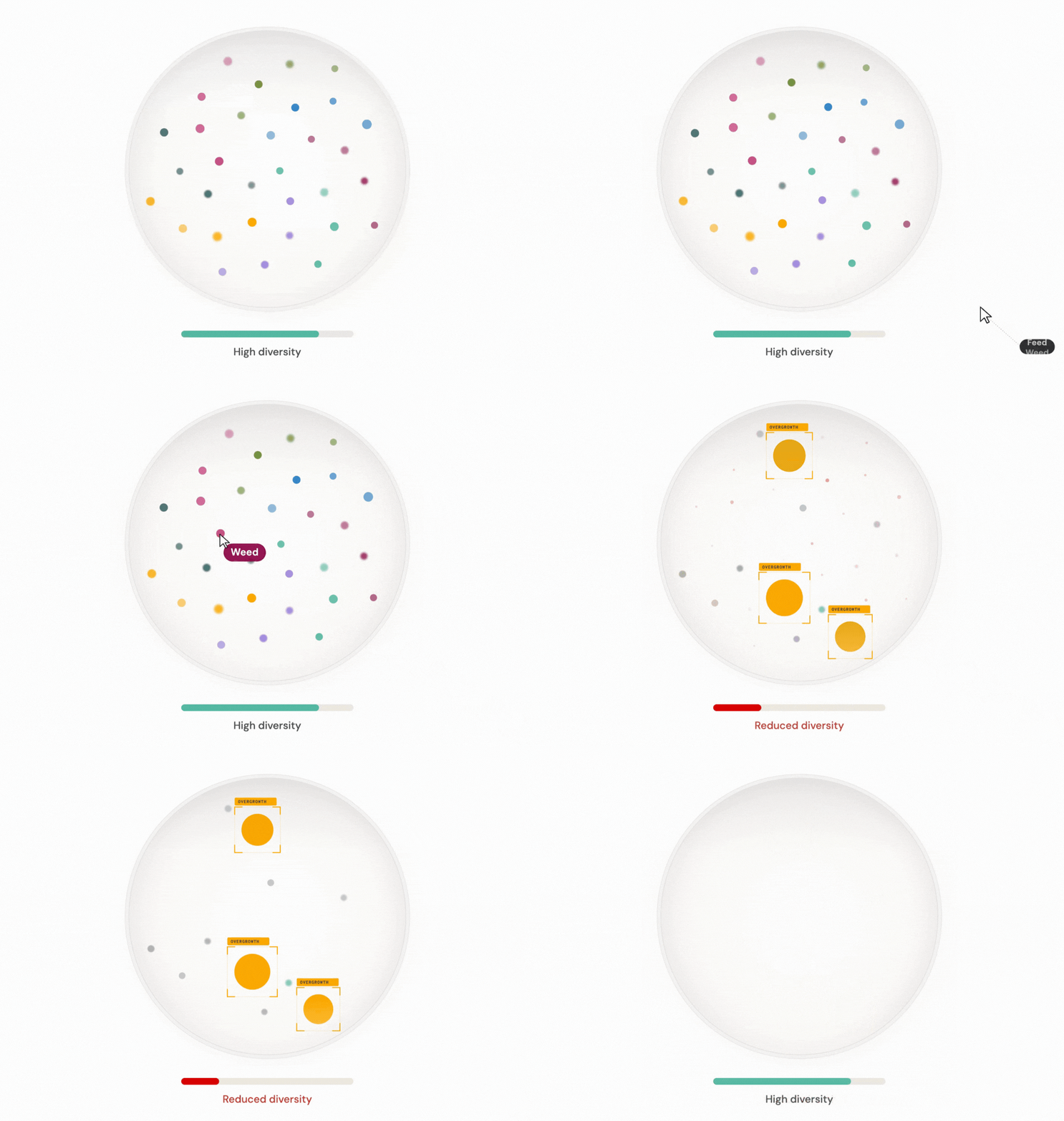
Every microbial species in the gut exists within a dense network of interactions. Species compete for nutrients and binding sites. They cross-feed — the metabolic output of one becoming the substrate for another. They modulate the gene expression of each other and the host. They collectively shape the immune environment.
When a practitioner removes a species that appears problematic, the competitive landscape shifts. Organisms that were held in check by that species may expand. Cross-feeding chains that depended on its metabolic output may collapse. The intervention may resolve the original concern — and create a new one.
When a practitioner introduces a species via supplementation, the organism enters an established community. Whether it colonises, persists transiently, or has no measurable effect depends on conditions the species-level report doesn't describe: the functional state of the existing community, the availability of ecological niches, and the competitive dynamics already in play.
The data gap
This isn't a failure of clinical reasoning. Practitioners are applying sound logic to incomplete data. A species-level report identifies what's present and in what relative abundance — but it doesn't describe the metabolic potential of the community, or assess the gut environment.
That gap creates a specific clinical risk: treatment plans that are confidently designed but unpredictably executed. The practitioner has a target. What they may not have is a reliable map of what surrounds it.
From target to map
Ecosystem-level analysis changes the foundation of the treatment decision. When a practitioner can see not just which species are present but what the community has the potential to do— the metabolic pathways present, the functional redundancies in the system, and markers of the gut environment — the treatment plan moves from targeting a single variable, to intervening in a system with visibility of the likely consequences.
Microba is designed for this shift. It reports community composition, functional pathways, and key markers of the gut environment alongside species identification — providing the context that turns a treatment target into a treatment strategy with a defensible rationale.
Read about why at Microba we recommend a feed, feed, feed approach to support the whole-ecosystem here.
Better science is better care. Expect Better.

Become a Microba practitioner
Create your free practitioner account to explore Microba, access education and resources and get ready to start testing.

1. Create your free account
Complete a short registration, tell us about your practice and set up your login. You’ll get immediate access to the practitioner portal and education hub.

2. Verify your account
Access the practitioner portal and education hub while we verify your credentials. Verification is required before you can order tests.

3. Start with Microba
Once verified, you can order tests for your patients, explore Microba’s product range and access practitioner resources.