Feed, feed, feed – not weed, seed, feed
.avif)
Why targeting individual species can be like pulling the wrong Jenga block – and what a whole-ecosystem approach means for microbiome care.
The “weed, seed, feed” model is one of the most recognisable frameworks in gut health: weed out the “bad” microbes, seed in the “good” ones, then feed them to rebuild a healthier community. It is intuitive, memorable and easy to explain.
But the gut microbiome does not behave like a garden that can be cleared, replanted and fertilised in sequence. It behaves more like a Jenga tower – an interlocking structure where pulling out the wrong block can bring down far more than intended.
This article examines what current evidence says about each step, why targeting individual species can destabilise the whole community, and why supporting the wider ecosystem it lives in – feed, feed, feed – is often the more defensible goal.
The gut is a tower, not a garden
The appeal of “weed, seed, feed” rests on a picture of the microbiome as a collection of independent plants: pull the weeds, add the flowers, apply fertiliser. Microbial ecology tells a different story. The gut is a dense, interconnected community whose members compete and cooperate, and whose behaviour depends as much on their neighbours and their surroundings as on their species name.
Three properties make the “tower” analogy more accurate than the “garden” one:
- Functional redundancy. Many different species carry overlapping metabolic capabilities, so two people with very different microbes can still perform similar functions.1 Loss of one species may not eliminate a function, because other community members can often contribute to the same capability – though removing many species at once can quietly knock out a function the community relied on.
- Cross-feeding and keystone species. Redundancy, though, is not uniform. Many outputs are built by chains of species working in sequence, and a few links can be more load-bearing than others. Resistant starch is a clear example: Ruminococcus bromii can act as a keystone primary degrader, breaking down resistant starch and releasing fragments that other community members, including Bifidobacterium and butyrate producers, can then ferment.2 Lose a keystone like that and the function can be disproportionately affected.
- Colonisation resistance and resilience. A diverse, balanced community competes for space and nutrients and shapes its local environment in ways that help keep opportunists in check. A resilient community can absorb a disturbance and recover; a depleted one has fewer partners and less redundancy to draw on.
Context is everything. In a gnotobiotic (germ-free) mouse model, Enterococcus faecalis behaved pro-inflammatorily on its own, yet protectively as part of a seven-species community – a reminder that what a microbe does can depend on the company it keeps.3 This is why the tower is the better picture. Most blocks can be removed without the structure noticing, because another block does the same job – that is redundancy.
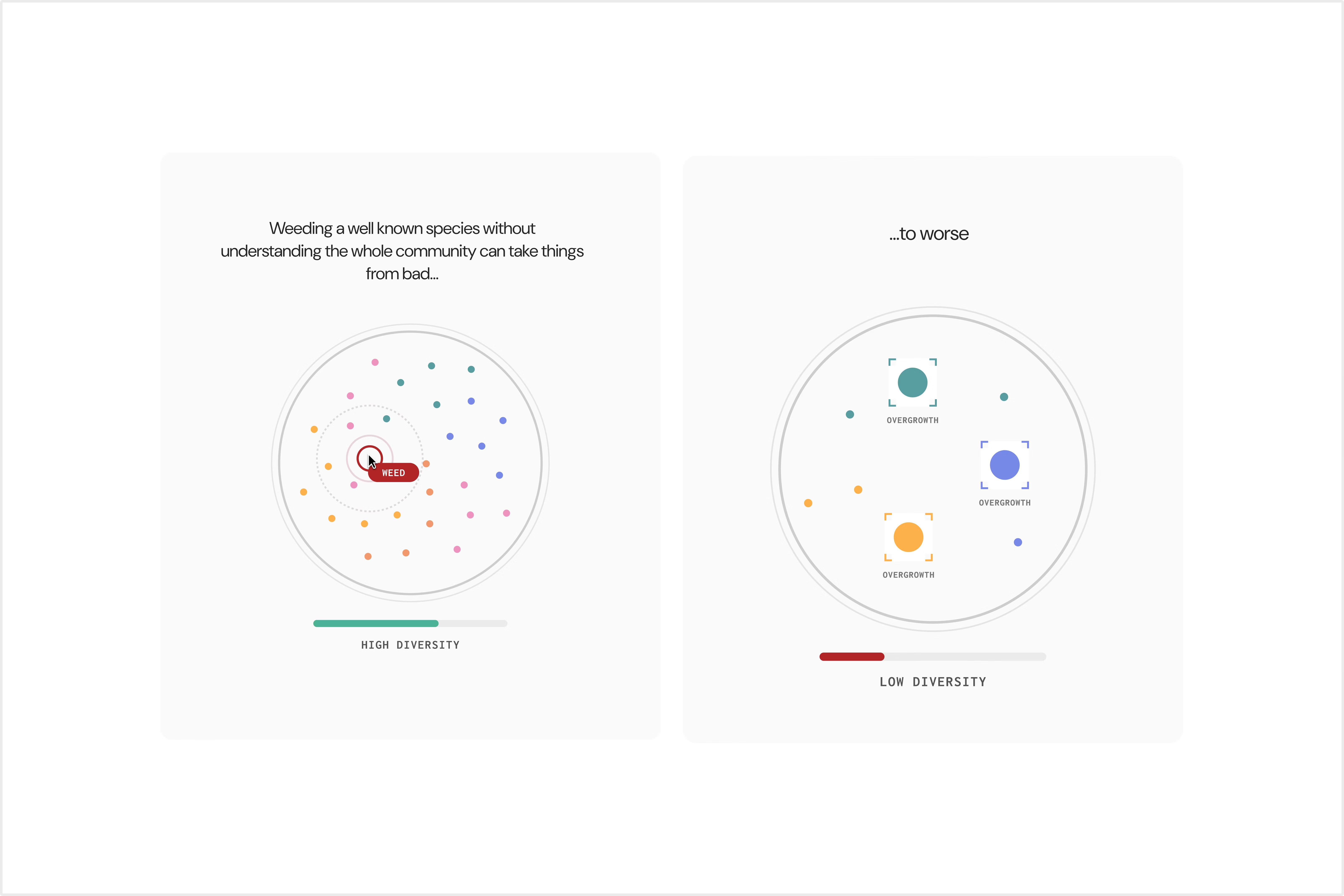
But a few are load-bearing: pull one of those and far more comes down than the single piece in your hand. The difficulty for anyone reaching in to “weed” is that a species list rarely shows which blocks are which – so removing microbes on the assumption that they are interchangeable is a gamble, not a targeted correction.
Weeding – removal is rarely as targeted as it looks
The first step assumes that symptoms are driven by identifiable “bad bugs” that can be selectively removed. In practice, the tools used to weed – broad-acting antimicrobial herbs and antibiotics – are often far less selective than the metaphor implies and can disrupt the wider community.
Berberine is a useful example. This plant alkaloid is widely used as a botanical antimicrobial and is generally considered non-selective. Two randomised controlled trials in people with impaired glucose tolerance found that 12–16 weeks of daily berberine reduced health-associated species, including Bifidobacterium spp. and butyrate producers, while increasing disease-associated species and hexa-acylated lipopolysaccharide (hexa-LPS) producers.4,5 An intervention often used with antimicrobial intent therefore produced broader community effects than a ‘weeding’ metaphor would suggest.
Antibiotics show the pattern more starkly. In 12 healthy men given a short broad-spectrum course, the immediate response was a bloom of Enterobacteria and pathobionts alongside depletion of Bifidobacterium and butyrate producers. The community recovered towards baseline within about six weeks, but several common species were still undetectable six months later.6 Removal is rarely clean, and recovery is neither guaranteed nor complete.
None of this means removal never has a role. A confirmed pathogen or a documented overgrowth may warrant targeted treatment. What the evidence does not support is a routine weeding phase for most patients on the basis of a nonspecific “imbalance”. Where removal is genuinely indicated, it is worth choosing approaches that protect the surrounding community rather than clearing the board.
Seed – reseeding is less predictable than it sounds
If weeding clears space, seeding is meant to fill it with beneficial microbes, usually through probiotics. Here too, the gardening picture tends to overpromise.
Probiotics can help in specific, defined situations, but their effects are generally modest and depend on the strain, dose, host and clinical context. Introduced strains may not establish long-term and colonisation varies markedly between individuals: in one detailed human study, an 11-strain probiotic produced only a transient, highly individualised effect on the gut lining, with colonisation patterns that varied markedly from person to person.7 Probiotics are also not universally risk-free, particularly in vulnerable groups such as immunocompromised or critically ill patients.
The practical implication is simple: you cannot reliably plant a new community into an existing one. The resident ecosystem – and the person's own biology – largely determines what takes hold.
It’s a two-way street: the microbiome and its environment
Underlying all of this is a point the model tends to miss – the microbiome and the gut environment shape each other continuously.
The community shapes its environment.
By fermenting fibre into short-chain fatty acids, gut microbes help lower luminal pH, making the colon less hospitable to some opportunists; they help maintain the mucus layer that keeps microbes and their products away from the gut wall; and they help train and tune the immune system. These are functions of a working community, not of any single species.
The environment shapes the community. Fuel availability is one of the strongest levers. When fermentable fibre is plentiful, many microbes produce short-chain fatty acids associated with barrier and immune support. When it is scarce, community metabolism can shift toward greater use of protein-derived substrates – generating metabolites such as hydrogen sulphide, ammonia and trimethylamine that, in excess or in susceptible people, may contribute to irritation and inflammatory signalling – or turn to the host's own mucus for fuel. In a fibre-deprived gnotobiotic mouse model, the microbiota degraded the protective colonic mucus layer and left the animals more susceptible to an enteric pathogen.8 Host factors such as transit time, inflammation and immune status also help determine whether a given microbe stays a quiet resident or becomes symptom-relevant.
This two-way relationship is why context matters so much – and it points to a more productive target than any single organism: rather than fighting the community, you can change the conditions it works within.
Feed, feed, feed – but feed with intent
Of the three steps, feed rests on the firmest ground. Diet is one of the most reproducible influences on the microbiome, and nourishing the resident community – rather than demolishing and rebuilding it – works with the ecosystem's own dynamics. Feeding fermentable fibres supports the fibre-degrading, short-chain-fatty-acid-producing functions that underpin colonisation resistance, barrier maintenance and immune regulation. This is the logic behind reframing the sequence as feed, feed, feed: sustained, ecosystem-level nourishment rather than a weed-and-seed cycle.
But feed is not a universal prescription either, and it would be a mistake to swap one oversimplification for another. Responses to the same fibre differ between people; fibres differ in how readily they ferment, which microbes they favour and how well they are tolerated; and some people experience bloating or worsening symptoms as fibre increases. The principle, then, is to feed thoughtfully – match the type, dose and pace to the individual, start low and go slow, and prioritise sustainable dietary patterns over generic supplementation.
What this means in practice
- Start with the whole picture, not a hunt for culprits. Assess diversity, richness and functional capacity rather than relying on individual species alone.
- Reserve weeding for clear indications. Confirmed pathogens and objectively documented overgrowth (confirmed by validated testing, not inferred from relative abundance) may warrant targeted treatment; nonspecific “imbalance” usually does not. When removal is needed, protect the surrounding community.
- Treat probiotics as targeted tools, not a rebuild. Use specific strains for defined purposes rather than relying on them to reconstruct a community.
- Make nourishment the backbone. Support the whole community's functions with individualised dietary strategies, and judge success by how the patient feels and functions – not by chasing an idealised profile.
The shift is from a linear, three-step reset to an ongoing, ecological partnership with the community a patient already has. In short: fewer blocks pulled, more of the whole tower supported.
Key takeaways
- The gut microbiome behaves like an interlocking tower, not a garden of independent plants: most species are functionally redundant and support one another through cross-feeding and colonisation resistance, but a few are load-bearing keystones – and a species list rarely tells you which block is which.
- “Weeding” tools are often not selective. Two RCTs found berberine reduced beneficial species and increased disease-associated and hexa-LPS-producing species, and broad-spectrum antibiotics can leave a lasting imprint even after apparent recovery.
- “Seeding” with probiotics tends to produce transient, individualised effects, and introduced strains often fail to establish.
- The microbiome and gut environment shape each other, so changing the conditions – especially the available fuel – is often more productive than targeting individual microbes.
- “Feed, feed, feed” – nourishing the whole ecosystem – is the best-supported approach, as long as it is individualised rather than generic.
- Targeted removal still has a place for confirmed pathogens or overgrowth. The case here is against routine, nonspecific weeding – not against all intervention.
1. Tian, L. et al. Deciphering functional redundancy in the human microbiome. Nat. Commun. 11, 6217 (2020). https://doi.org/10.1038/s41467-020-19940-1
2. Ze, X., Duncan, S. H., Louis, P. & Flint, H. J. Ruminococcus bromii is a keystone species for the degradation of resistant starch in the human colon. ISME J. 6, 1535–1543 (2012). https://doi.org/10.1038/ismej.2012.4
3. Lengfelder, I. et al. Complex bacterial consortia reprogram the colitogenic activity of Enterococcus faecalis in a gnotobiotic mouse model of chronic, immune-mediated colitis. Front. Immunol. 10, 1420 (2019). https://doi.org/10.3389/fimmu.2019.01420
4. Zhang, Y. et al. Gut microbiome-related effects of berberine and probiotics on type 2 diabetes (the PREMOTE study). Nat. Commun. 11, 5015 (2020). https://doi.org/10.1038/s41467-020-18414-8
5. Ming, J. et al. Effectiveness and safety of Bifidobacterium and berberine in human hyperglycemia and their regulatory effect on the gut microbiota: a multi-center, double-blind, randomized, parallel-controlled study. Genome Med. 13, 125 (2021). https://doi.org/10.1186/s13073-021-00942-7
6. Palleja, A. et al. Recovery of gut microbiota of healthy adults following antibiotic exposure. Nat. Microbiol. 3, 1255–1265 (2018). https://doi.org/10.1038/s41564-018-0257-9
7. Zmora, N. et al. Personalized gut mucosal colonization resistance to empiric probiotics is associated with unique host and microbiome features. Cell 174, 1388–1405.e21 (2018). https://doi.org/10.1016/j.cell.2018.08.041
8. Desai, M. S. et al. A dietary fiber-deprived gut microbiota degrades the colonic mucus barrier and enhances pathogen susceptibility. Cell 167, 1339–1353.e21 (2016). https://doi.org/10.1016/j.cell.2016.10.043