The science behind Microba GI Navigator
_2026-07-11_13-01-51.avif)
How an integrated approach brings together metagenomic profiling, pathogens, gastrointestinal markers and patient information to provide a comprehensive view of gut health
Executive summary
The gut microbiome, intestinal environment and host physiology play important roles in digestion, immune regulation and metabolism. Interest in gut health has grown rapidly, yet the information used to understand it is often generated across separate tests — a gastrointestinal marker measured in one place, a microbiome profile generated in another — with each result considered independently. Bringing these complementary layers together can provide broader clinical context.
Microba GI Navigator is designed to close that gap. It integrates four complementary types of information within a single test ordered through a healthcare practitioner: microbial profiling and functional markers derived from shotgun metagenomics, a molecular pathogen panel using CE-marked assays, gastrointestinal markers measured using CE-marked assays, and structured patient-reported information including symptoms and diet. Rather than presenting these as isolated result sets, GI Navigator brings them together within a single report.
Every microbial marker earns its place through an evidence-gated framework. Candidate markers must satisfy three independent tiers of evidence: a plausible biological mechanism, reproducible associations in peer-reviewed human studies, and a statistically significant association in Microba’s internal dataset of more than 19,000 consented metagenomes. This disciplined approach limits the report to markers with genuine scientific support. Markers are then weighted by the strength of their link to one of 22 clinical Interpretations, and Interpretations are reported as “Evident”, “Possibly Evident” or “Not Evident” using explicit, transparent logic.
Microbial results are compared against a carefully defined healthy group of 502 individuals whose samples were collected and processed through the same workflow as every other sample. Gastrointestinal markers are interpreted against the reference ranges established by the assay manufacturers.
This paper describes the scientific and technological foundations of Microba GI Navigator: how the four types of information are measured and evaluated, how the underlying evidence is curated, and how this integrated approach differs from earlier forms of gut health testing. Throughout, the emphasis is on transparency and scientific rigour. Microba GI Navigator is ordered through, and its results interpreted by, a healthcare practitioner; it is not a self-diagnosis tool.
Introduction
The human gut is home to trillions of microorganisms whose combined genome encodes metabolic capabilities far exceeding those of the human genome alone.1 Over the past two decades, large sequencing studies have shown that the composition and function of this microbial community differ between individuals and are associated with many aspects of health.2 A gut microbiome that differs from the pattern seen in healthy individuals – often described as dysbiosis – remains an active area of research.3
For both practitioners and the people being tested, the practical question is whether these different aspects of gut health can be measured accurately enough, and interpreted carefully enough, to provide useful clinical context. Answering that question often requires more than one type of information. Molecular assays can detect established gastrointestinal pathogens. Stool-based gastrointestinal markers can provide complementary information about intestinal inflammation, digestive function, mucosal immunity, gastrointestinal bleeding and the gut environment. Metagenomic profiling reveals which microbial species are present and the metabolic functions the community has the potential to perform. And a person’s own symptoms, diet and other clinical information provide the context needed to give those measurements meaning.
Many gut health tests available today rely on older measurement methods. Culture, quantitative PCR and 16S ribosomal RNA gene (16S) sequencing each provide only a partial view: 16S sequencing typically resolves organisms only to the genus level and cannot reliably assess microbial function, while targeted panels report only a predefined list of organisms.4,5 Shotgun metagenomics – sequencing DNA from across the whole community rather than from a single gene – expanded what is possible, enabling species-level identification alongside analysis of the metabolic genes and pathways the community carries.5,6
Microba GI Navigator builds on this foundation. It combines a CE-marked molecular pathogen panel, gastrointestinal markers measured using CE-marked assays, high-resolution metagenomic profiling and structured patient information within a single test and – importantly – it integrates them into shared clinical-themed Interpretations.
This paper explains how the underlying evidence is curated, how the different types of information are measured, and how the test is designed to support practitioner-led care. The metagenomic microbiome component is provided for research use and is intended to provide additional information for consideration alongside the patient’s broader clinical picture, not to replace clinical judgement.
A unified test: four types of information
Microba GI Navigator draws on four complementary types of information. Each answers a different question, and their value increases when they are considered together.

Microbial markers
Microbial markers are derived from shotgun metagenomic sequencing of a stool sample, which provides a species-level profile of the gut microbiome together with an assessment of its functional potential.
Because different species within a single genus can behave very differently, species-level resolution matters – and it is something genus-level 16S sequencing cannot reliably provide.5 Beyond identifying which organisms are present, metagenomics can assess the community’s genetic potential to carry out specific functions. Examples include the potential to produce butyrate, hydrogen sulphide, trimethylamine or hexa-acylated lipopolysaccharide, or to break down the protective mucus layer. These markers describe what the microbial community may be capable of doing, rather than simply which organisms are present.
Pathogen panel
A CE-marked, molecular (PCR-based) pathogen panel detects a defined set of established gastrointestinal pathogens. Because these are recognised organisms rather than variable members of the wider community, results are reported categorically rather than compared against a healthy reference range. A small number of organisms whose significance is less certain are reported separately and conservatively.
Gastrointestinal markers
Microba GI Navigator also includes a panel of gastrointestinal markers measured from the stool sample. These provide host-derived information about gut function and health and are measured using CE-marked assays within their defined intended use, with results interpreted against the manufacturers’ reference ranges. A small number of additional measures are included for research purposes only. Together, these markers add host-derived context that can be considered alongside the microbial findings.
.avif)
Patient information
Patient markers capture structured information reported by the person being tested, including selected medical history and medication use, physical symptoms, gastrointestinal symptoms, general wellbeing and dietary patterns. This information is captured in a structured way and considered alongside the GI markers and microbial data, rather than being treated as incidental context or presented in isolation.
How microbial markers earn their place: the evidence-gated framework
Not every microbial signal is meaningful. To ensure that the microbial markers reported in Microba GI Navigator are supported by robust evidence, each candidate marker must pass through a three-tier, evidence-gated framework. Generally, only markers that satisfy all three tiers are included, with limited and clearly disclosed exceptions.
Tier 1 – Plausible biological mechanism. There must be in-vitro, in-vivo or other mechanistic evidence providing a biologically plausible explanation for the relationship between the microbial marker and the aspect of gut health being assessed. For example, the link between a high capacity to degrade mucus and the integrity of the gut barrier is supported by in-vivo studies showing that, when dietary fibre is scarce, mucin-degrading microbes can increase in abundance and consume the protective mucus layer, bringing bacteria into closer contact with the gut lining.7,8
Tier 2 – Reproducible human associations. At least two peer-reviewed human studies must demonstrate a direct or indirect association between the microbial marker and the aspect of gut health assessed. Direct evidence links the marker to a clinical measure of that aspect of gut health; indirect evidence reproducibly links the marker, or a metabolite derived from it, to a related health outcome.
Tier 3 – Significant association in Microba’s in-house dataset. The marker must show a statistically significant association (false discovery rate < 0.05), of at least a small effect size, with a related health outcome in Microba’s database of more than 19,000 consented metagenomes. All analyses are controlled for age, sex, body mass index and stool consistency. This step confirms that a marker supported by the published literature also reproduces in a large, independent cohort processed through Microba’s own laboratory and analysis pipeline.
Exceptions apply where internal validation is not feasible – for example, because of limited numbers in a relevant group – or where a marker is not expected to distinguish between health states (for example, acetate production potential).
Once a marker qualifies, its contribution is weighted by the strength of the evidence linking it to the aspect of gut health being assessed, so that better-supported markers carry more weight than more preliminary ones.
Bringing the data together
Generating accurate data is necessary but not sufficient. To be useful, the different types of information need to be drawn together rather than read in isolation. Microba GI Navigator organises the microbial, gastrointestinal and patient marker data into a single, structured report that is provided to the healthcare practitioner who ordered the test.
GI Navigator applies defined interpretation logic across these data types to generate 22 Interpretations, each bringing together findings relevant to a particular biological or clinical theme. These include areas such as pro-inflammatory microbiome patterns, gut inflammation, slower colonic transit and reduced colonic butyrate availability. By considering related findings together, the Interpretations provide context that may not be apparent from any single marker alone.
Interpretations rated Evident or Possibly Evident are surfaced as Key Findings – the results most likely to warrant a practitioner’s attention. Each Key Finding is paired with one or more evidence-graded Suggested Actions, so that the report not only describes the finding but also presents available evidence based on currently available science, for what may be done in response.
The report is designed to support the practitioner’s own assessment in the context of the person’s history, symptoms and other clinical findings. It is intended to inform that assessment; it is not a diagnosis and is not designed to be used on its own.
.avif)
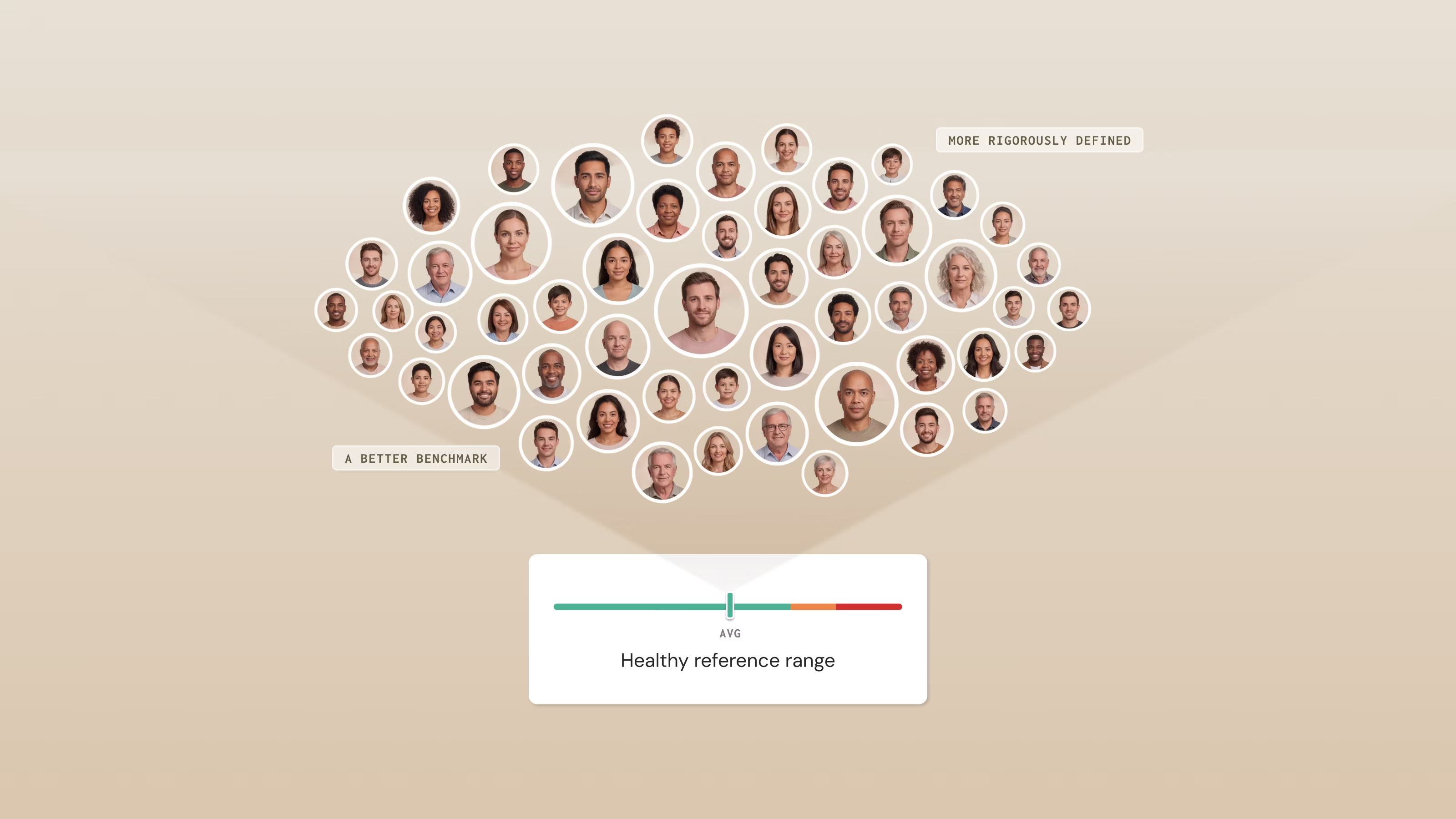
Benchmarking against a defined healthy reference cohort
A result gains meaning through comparison with an appropriate reference, and the appropriate comparator depends on the type of information being assessed. Microba GI Navigator is explicit about the reference used for each data type.
Microbial markers are compared with Microba’s healthy reference cohort: metagenomic profiles from 502 individuals selected using defined health criteria.
These include absence of major health conditions and regular gastrointestinal symptoms; general psychological wellbeing; no regular use of medications known to strongly affect the gut microbiome; and lifestyle characteristics consistent with general good health, including a body mass index below 30, daily fruit and vegetable intake, and low-to-moderate alcohol consumption.
Importantly, samples in the healthy reference cohort were collected, processed and analysed using the same workflow applied to tested samples. This reduces an important source of technical variation when comparing microbiome results. Reference cohorts assembled from datasets generated using different collection, laboratory or analytical methods can introduce variability that reflects methodology rather than underlying biological differences.
Gastrointestinal markers measured using CE-marked assays are interpreted against the reference ranges established by the assay manufacturers. Pathogen results and patient-reported information are interpreted according to their respective reporting criteria rather than against the microbiome healthy reference cohort.
Technology and quality foundations
The findings described above are only as reliable as the data that underpin them. Microba GI Navigator is built on the same validated technology platform used across Microba’s microbiome testing. Key elements are summarised below.
Sample preservation. Stool samples remain biologically active after collection, so microbial composition can change if a sample is not adequately preserved. Microba uses a swab-based, active-drying collection tube that was benchmarked against commonly used room-temperature preservation methods in a peer-reviewed shotgun metagenomic study. It showed the best overall performance among the methods tested for technical reproducibility and compositional stability and maintained its performance across a range of storage temperatures, supporting its suitability for postal collection.9
Accredited, automated laboratory. Sequencing, gastrointestinal marker assays and the pathogen panel are performed in a NATA-accredited medical laboratory operating to ISO 15189 standards. The laboratory uses a high level of automation, supported by an automated quality-control pipeline that monitors samples throughout processing. Software systems used to analyse and interpret metagenomic data are developed under an ISO 13485 quality management system for software as a medical device.
Shotgun metagenomics and the Microba Community Profiler. Shotgun metagenomic sequencing analyses DNA extracted from a stool sample, providing a broad, untargeted profile of the microbial community and its genetic functional potential.6 Sequencing reads are classified using the Microba Community Profiler (MCP), Microba’s proprietary whole-genome alignment tool. In a peer-reviewed benchmarking study, MCP was compared with nine widely used academic metagenomic classifiers across 140 simulated microbial communities. It achieved the highest combined precision and recall among the classifiers evaluated, while maintaining very high precision and substantially reducing false-positive species calls.10
Accurate species identification is important because false-positive detections can lead to misleading interpretations of an individual microbiome profile.
What distinguishes Microba GI Navigator
Integration across four types of information. Microbial, pathogen, gastrointestinal and patient data are combined into shared Interpretations rather than presented as separate, disconnected result sets. This makes it possible to consider relationships across data layers that would be missed if each were viewed alone.
High-resolution metagenomics. Species-level shotgun metagenomic profiling and community-wide assessment of functional potential provide substantially greater resolution than the predominantly genus-level information from conventional 16S sequencing or the predefined targets of qPCR panels.5
Evidence-gated marker curation. Microbial markers are reported only where supported by mechanistic plausibility, reproducible human evidence and validation in Microba’s internal dataset, with limited and clearly disclosed exceptions. This reduces the inclusion of markers with insufficient scientific support.
Transparent, evidence-graded actions. Suggested Actions are ranked using explicit criteria, assigned NHMRC Grades of Recommendation and linked directly to the studies used in their assessment.
Restraint where clinical significance is uncertain. Organisms for which clinical significance remains uncertain are reported separately and interpreted conservatively, helping reduce the risk of overinterpretation.11
Like-for-like benchmarking and robust quality systems. Microbial results are compared with a healthy reference cohort whose samples were collected, processed and analysed using the same workflow. Testing is performed within a NATA-accredited medical laboratory operating to ISO 15189 standards, while software used to analyse and interpret metagenomic data is developed under an ISO 13485-certified quality management system.
Limitations
Transparency about limitations is essential to the responsible use of microbiome results.
The metagenomic microbiome component of Microba GI Navigator is provided for research use and is not a diagnostic test. Its results are intended to be considered by a qualified practitioner alongside the person’s history, symptoms and other findings, and are not intended to diagnose, treat or prevent disease. The pathogen panel and gastrointestinal markers are used within their defined intended purposes.
Shotgun metagenomics measures microbial DNA in a stool sample. It provides information about microbial composition and the genetic capacity of the community to perform particular functions, but does not directly measure gene expression, metabolite production, host exposure or clinical effect. Stool also represents one sampled compartment of the gastrointestinal microbial community and may not reflect microbes associated with other intestinal locations.
The scientific framework is designed to evolve as the evidence develops. Microbial markers are generally selected on the basis of mechanistic plausibility, reproducible human evidence and validation in Microba’s internal dataset, with a small number of clearly disclosed exceptions. Associations do not necessarily establish causation, and the clinical relevance of a finding depends on the wider microbial and patient context. Microba continues to review and refine the test as microbiome science advances.
Conclusion
Microba GI Navigator represents a considered step towards more integrated gut health testing. By bringing together a CE-marked pathogen panel, gastrointestinal markers measured using CE-marked assays, high-resolution metagenomic profiling and structured patient information — and integrating these data within a single report — it provides a more comprehensive view than any one layer can provide alone.
The approach is designed to support robust and transparent interpretation: an evidence-gated framework that prioritises well-supported markers, considered logic that evaluates all markers within an Interpretation, evidence-graded Suggested Actions linked to their supporting studies, and comparison with a healthy group processed using the same workflow.
The metagenomic microbiome component is provided for research use and is intended to add information for a healthcare practitioner to consider alongside the person’s history, symptoms and other clinical findings. It is not intended to replace clinical judgement.
As microbiome science advances, Microba is committed to continually reviewing the evidence and responsibly incorporating well-supported advances into its testing and interpretation framework.
View References