Metagenomics is not a guarantee - why methodology matters more than the label

Not every metagenomic test is built to the same standard. The difference often comes down to what happens between the sample and the report — and most practitioners never see that process.
The label problem
Metagenomics has become a proxy for quality in microbiome testing. When a test says "metagenomic," practitioners reasonably assume it delivers species-level resolution, comprehensive coverage, and clinically reliable data.
But the term describes a technology category, not a standard of execution. Two laboratories can both run metagenomic sequencing and produce fundamentally different results from the same sample — because the variables that determine accuracy sit beneath the label.
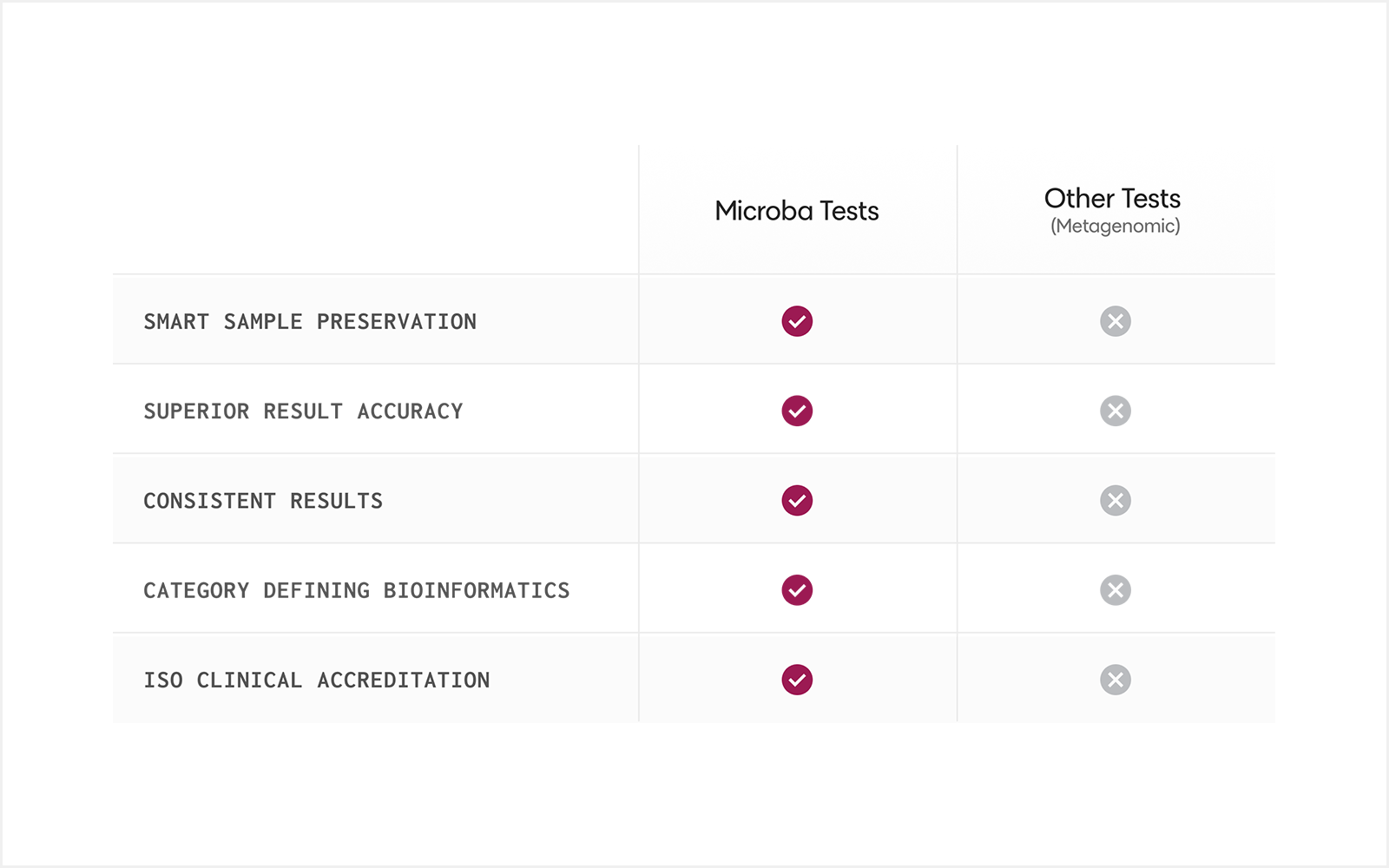
Where the differences hide
Processing, the data is compromised before sequencing even begins. Microba uses a validated preservation method, with stability demonstrated over 4 weeks at temperatures up to 50°. Others don't.
Bioinformatic pipelines — the computational analysis that translates raw sequence data into a clinical report — vary in their reference databases, their taxonomic classification methods, and their thresholds for calling a species present or absent. A pipeline built on an incomplete reference catalogue will return incomplete results. If the bioinformatic pipeline does not reliably identify species or estimate their relative abundances, it may falsely indicate an imbalance or fail to detect one that is present. Microba's bioinformatic pipeline is validated and benchmarked against widely used metagenomic classifiers in a peer-reviewed publication. Consistently.
Resolution matters because clinical decisions require specificity. Genus-level data tells you a group of organisms is present. Species-level and strain-level data tells you which ones — and the clinical significance of closely related organisms can differ substantially. Resolution is only half of the advantage. Unlike 16S rRNA sequencing, which reports only who is present, shotgun metagenomics also reveals what the community is capable of doing — the metabolic pathways it carries — and that functional picture is where the clinical relevance sits.
Laboratory accreditation is the framework that governs all of this. An ISO 15189-accredited medical laboratory operates under externally audited quality management systems, validated analytical processes, and documented proficiency testing. A commercial laboratory may follow internal quality protocols — but the external accountability and regulatory oversight is not the same.
Why this matters in your clinic
These aren't abstract distinctions. They show up in your patient's report as the data you use to build a treatment plan. If the resolution is insufficient, you may miss clinically relevant organisms. If the bioinformatic pipeline does not reliably identify species or estimate their relative abundances, it may falsely indicate an imbalance or fail to detect one that is present.If sample preservation was inadequate, the proportions in the report may not reflect the proportions in the patient.
None of these failures are visible in the final report. The report looks complete. It looks authoritative. It may simply be wrong in ways that are difficult to detect without running the same sample through a more rigorous process.
The standard that should exist
The clinical microbiome testing category is still young enough that there is no universal standard for what "metagenomic" must mean in practice. That creates a responsibility for practitioners to interrogate the methodology behind the tests they order — not just the technology on the label.
Questions worth asking of any provider: Is the laboratory ISO 15189 accredited? What sample preservation method is used, and is it validated? What is the species resolution — genus-level, species-level, or strain-level? How accurate is the bioinformatic analysis? Are the analytical methods externally audited and published in peer-reviewed articles?
Microba is built to answer every one of those questions with confidence. Shotgun metagenomic sequencing. Validated sample preservation. ISO 15189-accredited medical laboratory. 100% coverage of the approx. 5,000 gut microbial species¹. A bioinformatic pipeline benchmarked against leading microbiome profilers in peer-reviewed publications².
Better science is better care. Expect Better.
- ¹Almeida et al., Nature Biotechnology, 2021
- ² Built on an extended version of the microbial genome taxonomy database developed by Microba co-founder Prof Phil Hugenholtz.

Become a Microba practitioner
Create your free practitioner account to explore Microba, access education and resources and get ready to start testing.

1. Create your free account
Complete a short registration, tell us about your practice and set up your login. You’ll get immediate access to the practitioner portal and education hub.

2. Verify your account
Access the practitioner portal and education hub while we verify your credentials. Verification is required before you can order tests.

3. Start with Microba
Once verified, you can order tests for your patients, explore Microba’s product range and access practitioner resources.