Benchmarketing Microba's sample collection device

Introduction
Featured in ISME Communications New Development in Microbial Ecology
In recent years, the role of the gut microbiome in human health and disease has attracted significant attention.¹ With an increasing number of studies using stool-based gut microbiome analyses for the discovery of disease biomarkers and therapeutic targets, it is essential that the methods used to collect and store samples can provide accurate, stable and reproducible results.
Freezing at -20°C to -80°C is the accepted best practice for preserving stool samples, however this can be challenging in large-scale studies from multiple locations or in cases where freezers or dry ice are not available. Room temperature (RT) preservation methods are therefore commonly used until samples can be frozen.
To date, the evaluation of RT preservation methods have mostly used low-resolution sequencing to compare between a fresh or fresh-frozen sample²–¹⁰ (compositional stability), and most studies have not addressed if a method can reliably reproduce the same results (technical reproducibility).⁸˒¹¹–¹⁴ Given the importance of accurate microbiome analysis for developing diagnostics or therapeutic strategies, there is a need for more rigorous benchmarking studies to compare the performance of common stool collection methods.
In this study, we used metagenomic analysis of human stool samples to benchmark the technical and compositional reproducibility of Microba’s sample collection device, a Copan FLOQSwab in an active drying tube (FLOQSwab-ADT), along with four other RT microbial preservation methods (OMNIgene-GUT™, a dry BBL CultureSwab™, RNAlater™ and LifeGuard™) to the best practice of flash-freezing fresh samples.
All samples were stored at RT for up to four weeks (or the manufacturer’s maximum recommended time at RT) and methods were assessed using six replicate faecal samples from five participants, for a total of 180 metagenomes. The FLOQSwab-ADT was the best performing of the methods tested and was further evaluated with an additional ten participants (six replicates each) at three storage temperatures (240 total metagenomes) to determine its range of use.
All samples were processed using Microba’s Community Profiler v2.0.0 and Microba’s Genome Database v1. To our knowledge, this is the most comprehensive study to assess both the compositional stability and technical reproducibility of this number of RT preservation methods with shotgun metagenomic sequencing.
¹ Microba Life Sciences, Brisbane, QLD, Australia.
² Centre for Microbiome Research, School of Biomedical Science, Queensland University of Technology, Woolloongabba, QLD, Australia.
³ Australian Centre for Ecogenomics, School of Chemistry and Molecular Biosciences, The University of Queensland, St Lucia, QLD, Australia.
Correspondence to Dr Alena L. Pribyl, Microba Life Sciences Ltd. Level 12, 388 Queen St. Brisbane City, QLD 4000, Australia.
FLOQSwab-ADT has excellent technical reproducibility
Technical reproducibility is assessed by measuring the same sample multiple times with the same method. This provides a measure of the variability associated with the method. Here, we assessed the technical reproducibility of the five RT preservation methods and the flash-frozen control using six replicate stool samples from five individuals.
Bray-Curtis beta diversity was used to measure the difference in species profiles between the replicates from each method. This measure will fall somewhere between 0 and 1, where 0 means that the samples share all the same species, and 1 means that they do not share any species.
Species profiles from the BBL swab had significantly higher technical variability between replicates, whereas both FLOQSwab-ADT and OMNIgene-GUT had significantly lower technical variability compared to flash-frozen samples (Fig 1A). This can also be seen in the species profiles in Fig 1B, where FLOQSwab-ADT and OMNIgene-GUT have less variation between replicates from each participant compared to the other methods, including flash-freezing.
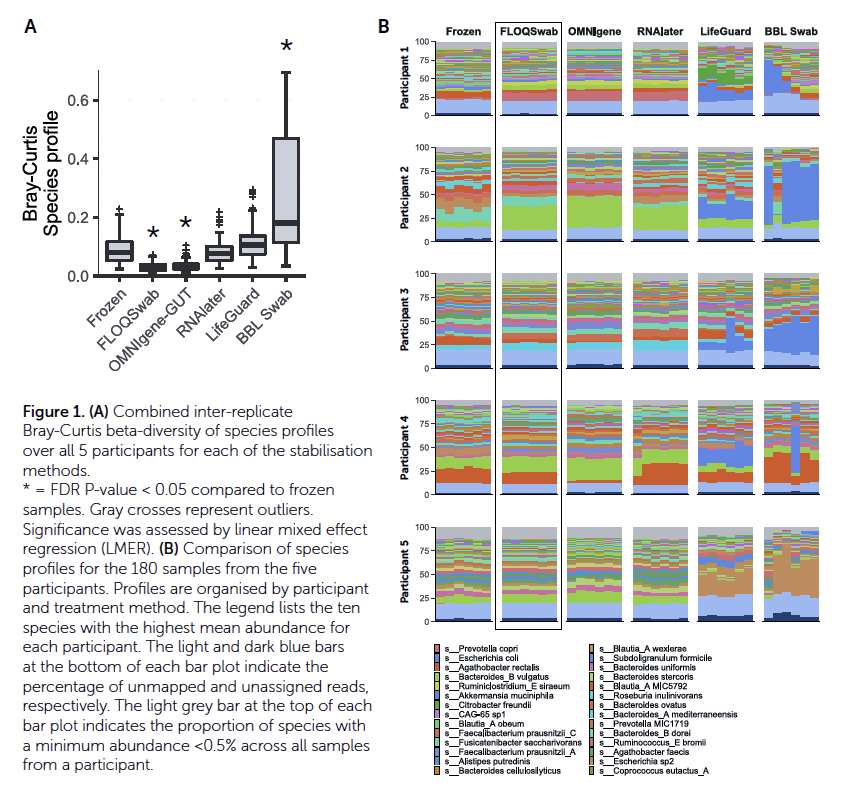
The FLOQSwab-ADT has better technical reproducibility than the commonly accepted best practice of flash-freezing.
FLOQSwab-ADT is superior at accurately preserving the microbial community
Different storage conditions can significantly alter the microbial community of a stool sample, as different microorganisms respond differently to environmental changes. It is essential to minimise these changes for accurate and reliable gut microbiome analysis to avoid false leads or inaccurate conclusions. Here we tested each of the five RT preservation methods for their ability to preserve the microbial communities in stool samples compared to flash-frozen controls.
Shannon (alpha) diversity was used to assess if there was a loss in microbial species or a change in their distribution across the different RT methods compared to flash-frozen samples. The FLOQSwab-ADT had the most similar Shannon diversity values compared to the flash-frozen samples, followed closely by RNAlater and OMNIgene-GUT (Fig 2A). In contrast, BBL swab and to a lesser extent, LifeGuard, had substantially reduced Shannon diversity relative to frozen controls.
Bray-Curtis beta-diversity was used to assess how closely the species profiles from each of the RT methods matched those of flash-frozen samples. The FLOQSwab-ADT had the most similar species profiles to frozen samples, followed by RNAlater, and LifeGuard. Species profiles from OMNIgene-GUT and BBL swab were the most different from flash-frozen samples (Fig 1B, 2B).
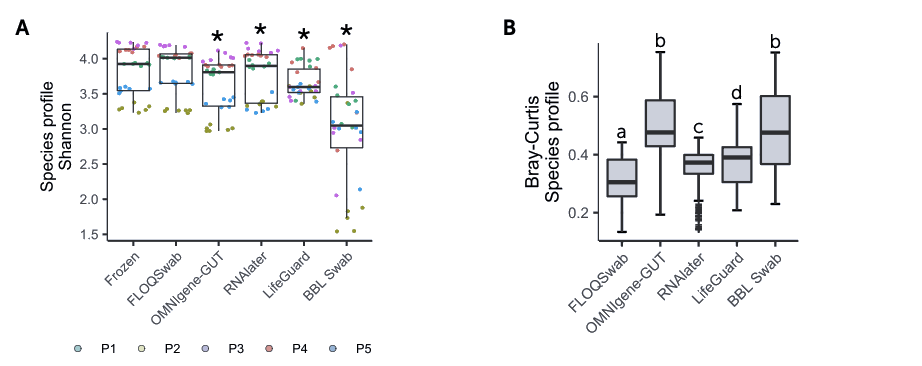
Figure 2.
(A) Shannon diversity based on species profiles across each storage method for all five participants. * = FDR P-value < 0.05 compared to frozen samples. Different colours represent different participants.
(B) Combined beta-diversity of species profiles over all 5 participants for each stabilisation method. Boxes that do not share the same letter are significantly different at FDR P-value < 0.05. Gray crosses represent outliers. Significance was assessed by linear mixed effect regression (LMER).
Interestingly, the most notable difference in species profiles was a large and inconsistent outgrowth of Escherichia coli or Escherichia sp2 in samples preserved with BBL swab and LifeGuard (Fig 1B).
Escherichia is a well-known facultative anaerobe – meaning it can survive without oxygen but will use oxygen when it is available – and it is generally found at low levels in the human gut. Our results show that BBL swabs and LifeGuard are unable to prevent the growth of facultative anaerobes during storage of stool samples at room temperature, which is particularly concerning for studies that are attempting to identify biomarkers for disease as they may cause researchers to pursue false leads.
Due to the low technical reproducibility and outgrowth of facultatively anaerobic species, we strongly recommend that BBL swabs and LifeGuard are not used for RT stool preservation.
The FLOQSwab-ADT outperformed all tested RT preservation methods at accurately preserving microbial communities when compared to flash-frozen samples.
FLOQSwab-ADT is versatile
We further evaluated the range of use of the FLOQSwab-ADT by assessing its ability to preserve stool microbial communities across three storage temperatures. To minimise technical variation in the control samples, this time we used freshly collected and extracted samples instead of flash-frozen samples.
Fresh stool samples were collected from ten individuals and either processed immediately (fresh) or stored on the FLOQSwab-ADT at -20°C, room temperature, and 50°C for four weeks. Six replicate samples from each of the ten participants and each temperature treatment was sequenced for a total of 240 metagenomes.
There was no difference in technical reproducibility of species profiles between fresh samples and those stored at room temperature and 50°C (Fig 3). Only the -20°C treatment had higher technical variability compared to fresh samples, although this difference was very small. Bar plots of species profiles from each replicate also show the excellent technical reproducibility of the FLOQSwab-ADT across all participants and temperature treatments (Fig 4).
We next compared the alpha and beta diversity of species profiles from the various temperature treatments to fresh samples. There were no differences in alpha diversity across all temperature treatments compared to fresh samples (Fig 5A), indicating there was no loss of microbial species or changes in their distribution when stored at the different temperatures on the FLOQSwab-ADT.
However, there were small but significant changes in how closely species profiles from each temperature treatment matched those from the fresh controls. The RT treatment preserved species profiles most closely to the fresh controls, followed closely by the samples stored at -20°C and at 50°C (Fig 5B). Additionally, bar plots of the species profiles show minimal shifts in community composition, regardless of the treatment (Fig 4).
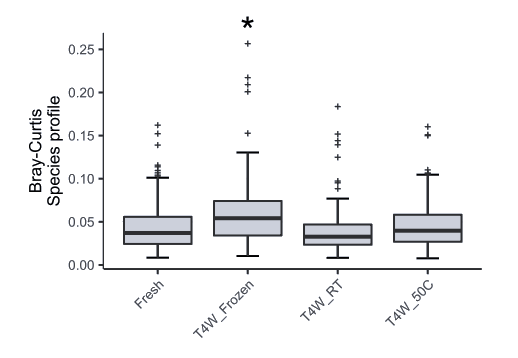
Figure 3.
Technical reproducibility of species profiles at each temperature treatment. Inter-replicate beta diversity values for all participants were combined for each treatment. T4W: Treatment 4 weeks, RT: room temperature. * = FDR P-value < 0.05 compared to fresh samples. Gray crosses represent outliers. Statistical significance was assessed by LMER.
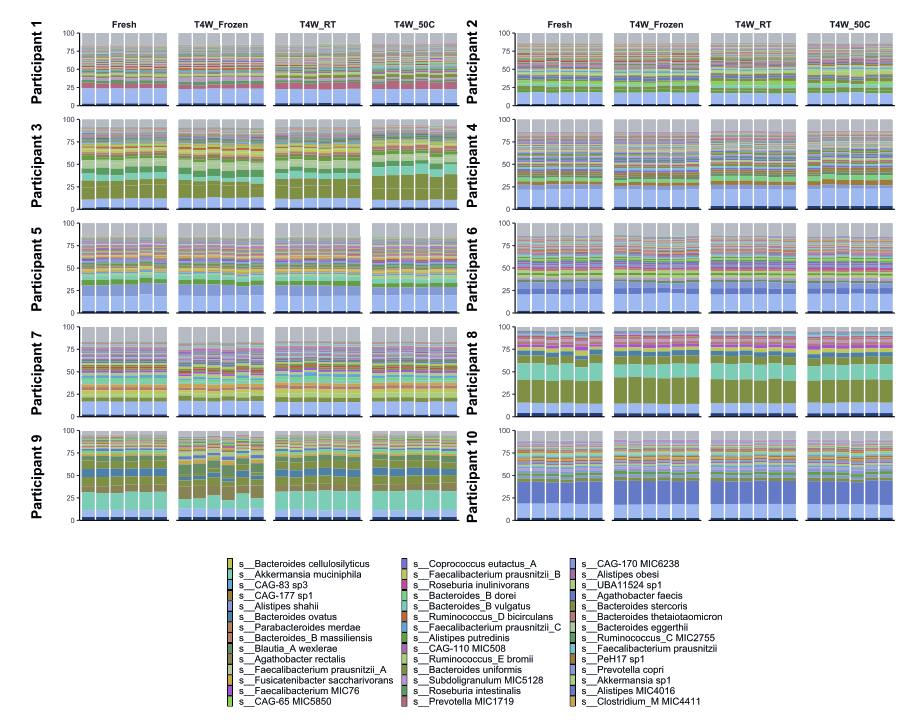
Figure 4.
Comparison of species profiles for the 240 samples from the ten participants. Profiles are organized by participant and treatment method. The bar charts list the ten species with the highest mean abundance for each participant. The light and dark blue bars at the bottom of each bar plot indicate the percentage of unmapped and unassigned reads, respectively. The light grey bar at the top of each bar plot indicates the proportion of species with a minimum abundance <0.5% across all samples from a participant.
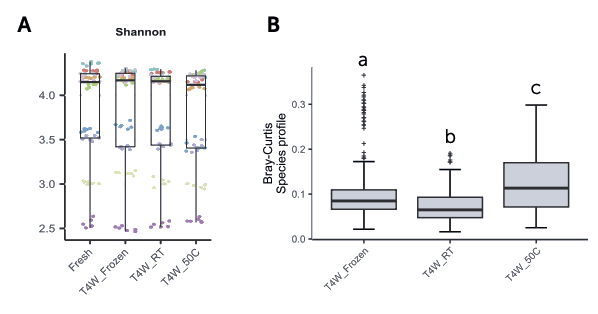
Figure 5.
(A) Shannon diversity of species profiles for all participants at each temperature treatment. Different colours represent different participants.
(B) Combined beta diversity of species profiles for each temperature treatment compared to fresh controls. Letters: Boxes that do not share the same letter are significantly different at FDR P-value < 0.05. Gray crosses represent outliers. Statistical significance was assessed by LMER.
The FLOQSwab-ADT can robustly preserve species profiles at -20°C, RT and 50°C for at least four weeks.
Summary
In this study, we rigorously evaluated five room temperature preservation methods for their ability to provide accurate and reproducible microbial community profiles compared to flash-frozen samples.
Although the FLOQSwab-ADT was originally designed for the collection of forensic DNA samples, we found it was the best performing RT preservation method tested when assessing both technical and compositional reproducibility. LifeGuard and BBL swab are not recommended for RT preservation due to outgrowths of facultative anaerobes such as Escherichia spp., which could significantly skew study results.
In addition to having the best performance at RT, we also show that the FLOQSwab-ADT is versatile, preserving microbial communities with high technical and compositional reproducibility at temperatures up to 50°C for at least four weeks. This makes FLOQSwab-ADT an excellent option for clinical and research use, especially where samples need to be collected and transported across long distances or sent through the post.
View References