Overview: Understanding the delicate Microbiome Ecosystem

The gut microbiome
The gut microbiome is best understood as a dynamic ecosystem shaped by host, environmental, and microbial interactions. Meaningful assessment depends less on the presence of individual organisms than on how the wider community is organised, what functions it is performing, and how those patterns may be influencing clinical presentation.
The microbiome is a dynamic ecosystem
The gut microbiome is a living, dynamic ecosystem. Its balance is shaped not by any single organism, but by the stability, diversity, and functional capacity of the entire community..1,2 Clinically, this shifts the focus from individual organisms to what the ecosystem is doing, how stable it is, and how those patterns may be shaping the patient’s presentation.
Microbiome balance is not defined by the presence or absence of certain organisms, but it is shaped by the following:

The microbiome ecosystem is composed of functional microbial communities
Potentially harmful organisms can be present in the gut without causing harm. What matters is not their presence alone, but the surrounding microbial community and host context. In a diverse and resilient microbiome, community- level interactions help keep such organisms in check and maintain stability, including through nutrient competition, pH modulation, and antimicrobial activity.3,4
Eradication alone does not restore balance
Eradication may reduce a population. But without restoring the ecological conditions that kept it in check, another organism may simply fill the vacancy — sometimes one less ecologically beneficial than what was there before.5 Diversity may decline further. Functional capacity may remain impaired.
Colonisation resistance
The significance of detecting a potentially harmful organism therefore depends on the condition of the wider ecosystem in which it is found. A resilient ecosystem may keep potentially harmful organisms in check, not necessarily by eliminating them, but through the competitive and metabolic pressures exerted by a diverse, functionally intact community.
The ecosystem keeps potentially harmful organisms ecologically controlled — not through eradication, but through the diversity and functional integrity of the community as a whole.6,7
Functional capacity
The collective ability of the gut microbiome to produce metabolites and support biological functions relevant to the host such as short-chain fatty acid production, immune regulation, and barrier support.2 It is a property of the community as a whole, shaped by interactions among organisms rather than any single member alone.
Targeting one organism is unlikely to restore gut health if the broader ecological drivers of dysfunction remain unchanged.
Functional outcomes depend on microbial community cooperation
Many of the microbiome’s most clinically relevant outputs are not produced by individual organisms, they emerge through cooperative chains of microbial activity, where one species’ metabolic output becomes another species’ fuel. This process is called cross-feeding.6
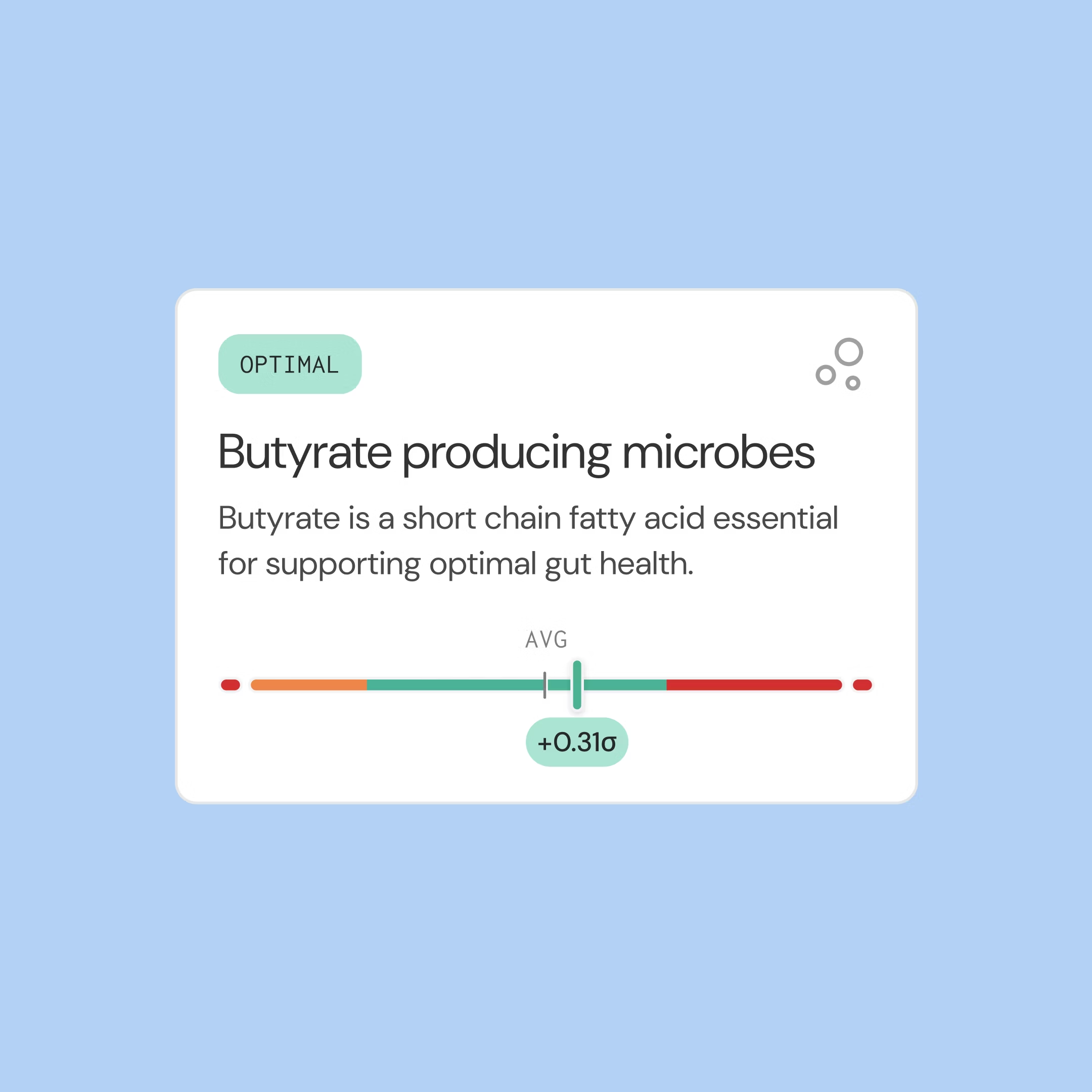
Butyrate is a clear example.
Butyrate is a clear example. Fibre-fermenting species produce intermediates; a distinct group converts those into butyrate — a key fuel for gut cells, a regulator of barrier integrity, and a contributor to immune tone.7 It is not the product of one organism. It requires many, working in sequence. Disrupt any part of that chain and butyrate output falls, regardless of whether any single organism appears absent.6,7
Interpreting the microbiome in context
The significance of any microbiome finding depends on its ecological context. That context includes at least three important considerations:
Presence alone is not enough
The presence of an organism is only one part of the picture. It does not indicate whether that organism is ecologically constrained or dominant, what functional role it is playing within the ecosystem, or whether it forms part of a stable or destabilising pattern.1
Dominance can change significance
Dominance patterns shape both metabolic output and community stability. The same organism may have very different implications depending on whether it is a member of a diverse community or dominant within a depleted one.1,2
What is missing can matter as much as what is present
Loss of protective organisms or functions can weaken ecological defences, making the microbiome less able to resist opportunistic expansion and maintain stable community function.4,6,7
Interpretation therefore needs to move beyond binary categories of “good” and “bad.” In many cases, the more informative question is how a finding fits within the wider ecosystem and what significance it may have for that individual.2
When community composition shifts health outcomes change
Changes in community composition, host factors, or environmental conditions can change the functional output of the microbiome, with downstream consequences for the host. When beneficial activities decline and less favourable outputs become more prominent, this can be understood as functional dysbiosis: a reduced capacity of the ecosystem to perform health-supporting functions.8
BALANCED
Fibre-fermenting microbial network intact. Cooperative species produce butyrate, supporting colonocyte fuel supply, barrier integrity, and anti-inflammatory signalling.7
DISRUPTED
Cooperative network disrupted. Butyrate output falls. Barrier integrity weakens, inflammatory signalling increases, regardless of whether any single organism appears absent.6
The clinical decision making changes when you see the whole ecosystem
The microbiome is shaped continuously by its relationship with the host and by environmental factors such as diet, medications, stress, and sleep. As a result, similar microbial findings can have different implications in different individuals. Microbiome balance therefore has no universal reference range, but is individual, dynamic, and context-dependent. An ecosystem view changes the clinical lens.
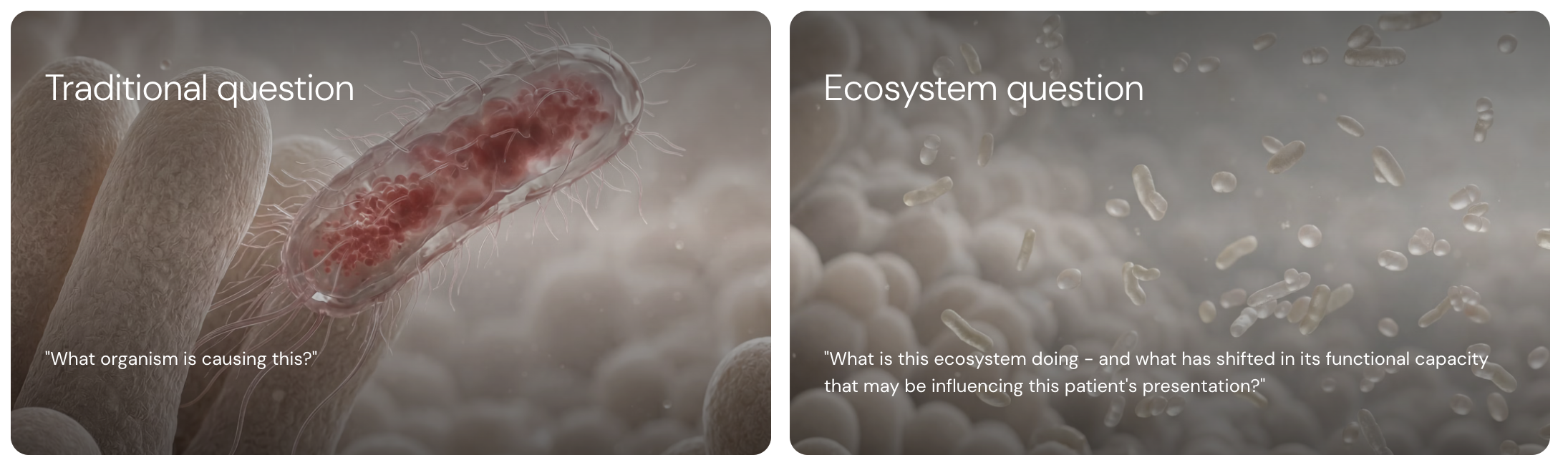
Seeing the microbiome as an ecosystem shifts clinical interpretation beyond whether a single organism is present, toward community patterns, functional output, and ecosystem resilience, and how these may relate to the patient’s presentation.
When you understand the ecosystem, you can support it
In practice, this means assessing microbial patterns rather than isolated species, interpreting functional capacity alongside composition, and considering ecosystem resilience.
Key takeaways
- Functional dysbiosis describes a disruption in the microbiome’s collective functional output, where the ecosystem’s capacity to carry out health-relevant activities has been altered.
- Restoring microbiome function may require more than targeting individual organisms; the wider ecosystem also needs to support stability and resilience.
- The microbiome is a dynamic ecosystem best understood in terms of the stability, diversity, and functional capacity of the whole community, not simply the presence and absence of specific organisms.
- The stability of the microbiome is shaped by ecological interactions such as competition, cooperation, and cross-feeding across species.
- The microbiome’s functional output depends on interactions across the community, so disrupting the network can disrupt function.
- The microbiome’s functional output depends on interactions across the community, so disrupting the network can disrupt function.
- The significance of any microbiome finding depends on its ecological context, not on whether a particular organism is simply present, absent, or abundant.
- Coyte KZ, Schluter J & Foster KR. The ecology of the microbiome: networks, competition, and stability. Science. 350, 663–666 (2015).
- Human Microbiome Project Consortium. Structure, function and diversity of the healthy human microbiome. Nature. 486, 207–214 (2012).
- Lozupone CA, Stombaugh JI, Gordon JI, Jansson JK & Knight R. Diversity, stability and resilience of the human gut microbiota. Nature. 489, 220–230 (2012).
- Sorbara MT & Pamer EG. Interbacterial mechanisms of colonisation resistance and the strategies pathogens use to overcome them. Mucosal Immunol. 12, 1–9 (2019).
- Buffie CG & Pamer EG. Microbiota-mediated colonisation resistance against intestinal pathogens. Nat. Rev. Immunol. 13, 790–801 (2013).
- Culp EJ & Goodman AL. Cross-feeding in the gut microbiome: ecology and mechanisms. Cell Host Microbe. 31, 485–499 (2023).
- Koh A, De Vadder F, Kovatcheva-Datchary P & Bäckhed F. From dietary fibre to host physiology: short-chain fatty acids as key bacterial metabolites. Cell. 165, 1332–1345 (2016).
- Tiffany CR & Bäumler AJ. Dysbiosis: from fiction to function. Am. J. Physiol. Gastrointest. Liver Physiol. 317, G602–G608 (2019).
- Procházková N et al. Gut physiology and environment explain variations in human gut microbiome composition and metabolism. Nat. Microbiol. 9, 3210–3225 (2024).